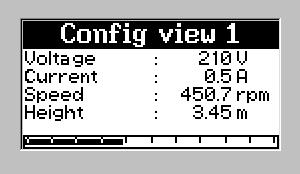
Dot Matrix LCD module Driver Library
KS0108 and HD61202 LCD controller family

|
FEATURES
|
- All common dot matrix LCD sizes supported by the controller (configurable)
- Support for display screens controlled by 1, 2 ,3, or 4 display controllers
- Library is designed for use with embedded processors. Small memory foot print
- Can operate directly on display controller RAM. No need for a graphic video buffer in RAM
- Written in C. Portable and C compiler independent with standardised I/O functions.
Can be used with embedded processors supported by a C, C++, or EC++ standard-conforming compiler.
- Character and text string functions
- Tabs and column alignment support
- Viewports with scroll, auto-wrap and auto-alignment
- Switching between multiple viewports
- Soft-font support.
- Mono-space and Proportional fonts.
- Black-on-White, White-on-Black.
- Full support for Virtual Fonts, icons, and pictures stored in external memory devices.
|
|
- Direct LCD memory I/O, or delayed update via RAM buffer
- Support for extended character sets. Multibyte character strings, wide-char strings
- Support for extended codepage tables, ISO-IEC 10646, and UNICODE.
- Full UTF-8 support, incl conversion functions
- Graphic Line drawing and pixel setting
- Graphic Rectangle and Block drawing
- Graphic buffer Cut and Paste
- Graphic Symbol and Icon support
- Free user definition of special symbols
- PC-simulator included for
debugging of target applications with standard PC compilers.
- Comprehensive easy-to-read manual with examples
- Library is supplied as C source code.
- Company site license for the source codes.
- No runtime license or royalties on compiled code.
- This library package is optimized for the KS0108 display controller family
- Graphic Controllers: KS0108B / KS0107B, S6B0108 / S6B0107, S6B0708, SBN0064 / SBN6400, HD61202 / HD61203, AX6108 / AX6107, PT6608 / PT6607, S60708, ST7548, NT7108, RA8808,
RW1065, KS0708, and equivalents.
|
|
Description
Advanced GUI (Graphic User Interface) driver library for Graphic KS0107B / KS0108B LCD modules.
Be up and running with your graphic KS0107B / KS0108B LCD module application using advanced
features like symbol and icon display, soft-font text and line drawing,
in just a few hours. Save weeks of hard programming.
The powerful and flexible function interface provides the basic drawing features
which make it simple for a programmer to create screen data fields, pull-down menus, pop-up menus,
progress bars, etc. The library facilitates the creation of any GUI "style" and "look"
most suitable for a particular target application area.
The library supports soft fonts for both mono-space and proportional graphic text.
All font handling is done transparently by the library. The programmer just
selects the wanted font.
Font support for 8-bit character sets, extended 16-bit character sets, national
ASCII character sets, ISO-IEC 10646, and UNICODE.
Supports dynamic codepage look-up and segmented fonts. This makes it possible to reduce a
large font so it only contains those character symbols used by the application, while
the C text strings remain unchanged. Ideal for memory-constrained embedded systems.
Multiple viewports with wrap and scroll. This makes it easy to reserve areas on the
display for icons and to prevent overwriting. Within a viewport text can be output
as left or right aligned, cut at the edges, or centered horizontally and vertically.
Each viewport can have its own font and code-page. Text scrolling can be done individually
for each view port.
Start programming and test before your hardware is ready. The PC-mode simulator for Windows
supplied with the library allows you to program and test embedded KS0107B / KS0108B LCD
applications, using common PC compilers from Borland and Microsoft. Your
LCD application source code will look the same in PC mode and target mode.
The library is written entirely in C using a standardized function syntax for basic I/O read and write. The
library is supplied as C source code and can therefore be compiled with
standard conforming C, C++, or EC++ compilers for all common embedded processor families. For instance: 80x51,
80x86, 80C167, 68HC11, 68HC16, 683xx, H8/300, H8/300H, H8S, M16, PIC17, PIC18, PIC24, PIC32, dsPIC, AVR, AT9x, ARM, etc.
The library functions are well modularized. Advanced features can be
added successively to the basic KS0107B / KS0108B LCD driver system. For instance: graphic
support, viewport support, symbol and icon support and soft-font text
support. This makes it easy to adapt the library to the requirements of your
application, and optimize ROM and RAM memory consumption.
The same LCD driver function interface exists for different LCD
controller types. This makes it easier to create portable and
reusable application software. Changing to LCD modules using
another LCD controller type is now a simple task.
|
Function overview
|
Version 6.1-7.5
|
|
|
Basic initialization and error handling |
|
ginit
|
Initialize display module
|
|
ghw_puterr
|
Initialize display and output an error message at the center of the display
|
|
gexit
|
Release display resources
|
|
gsetupdate
|
Activate / deactivate delayed update
|
|
ghw_err
|
Report error status from hardware drivers
|
|
ghw_dispoff
|
Turn off display screen
|
|
ghw_dispon
|
Turn on display screen
|
|
Basic text functions
|
|
gputs
|
Print a string.
The string may be an (UTF-8) multi-byte encoded string.
|
|
gputch
|
Print a character
|
|
gputcsym
|
Print a symbol as a character
|
|
ggetcxpos
|
Report cursor x position in character coordinates
|
|
ggetcypos
|
Report cursor y position in character coordinates
|
|
gsetcpos
|
Set cursor position in character coordinates
|
|
gsetpos
|
Set cursor position in graphic coordinates
|
|
gsetcursor
|
Set cursor size and type
|
|
ggetfw
|
Default width of current font
|
|
ggetfh
|
Height of current font
|
|
gfgetfw
|
Default width of a named font
|
|
gfgetfh
|
Height of a named font
|
|
ggetmbc
|
Fetch a char or a multibyte character from a string. The string pointer is advanced to the following character
|
|
gstrlines
|
Report number of text lines in a multi-line string
|
|
gsetspch
|
Set text character spacing. Add extra pixel space between text string characters
|
|
ggetspch
|
Report text character spacing
|
|
gsetspln
|
Set text line spacing. Add extra pixel space between text lines
|
|
ggetspln
|
Report text line spacing
|
|
Basic graphic functions
|
|
gcarc
|
Draw corner arcs as full circle, half circle, quarter circle.
Draw as perimeter, as filled area, or both.
|
|
gcircle
|
Draw circle as perimeter or as filled area.
Any perimeter fragment using any radius can be drawn. Center may be located outside screen.
|
gsetpixel
|
Write logical pixel using current viewport settings.
|
ggetpixel
|
Read pixel as logical value
|
grectangle
|
Draw a rectangular box using the current viewport setting.
|
|
groundrec
|
Draw rectangle with rounded corners. Create any figure from a pure rectangle to a circle.
Draw as perimeter, as filled area, or both.
|
|
gmoveto
|
Set start position for line draw
|
|
glineto
|
Draw line from last position to new position
|
|
ggetxpos
|
Report current pixel x position
|
|
ggetypos
|
Report current pixel y position
|
|
ghw_rdblk
|
Read display area to buffer
|
|
ghw_restoreblk
|
Write the display area stored in the buffer back to the same position as it was read by ghw_rdblk
|
|
ghw_wrblk
|
Write buffer to display area
|
|
ghw_blksize
|
Calculate needed buffer size for read block
|
|
Symbol (icon)
|
|
gputsym
|
Output a graphic b&w symbol
|
|
ggetsym
|
Read display area as a symbol
|
|
gfillsym
|
Fill area with a b&w symbol
|
|
gsymsize
|
Calculate minimum buffer size to hold a symbol
|
|
ggetsymw
|
Get the pixel width of a character symbol using the current font
|
|
gsymh
|
Report pixel height of symbol
|
|
gsymw
|
Report pixel width of symbol
|
|
|
Viewport functions
|
|
ggetvp
|
Report graphic viewport size
|
|
gsetvp
|
Set graphic viewport size
|
|
ggetvpnum
|
Report viewport number
|
|
gsetcvp
|
Set character viewport size
|
|
gsetupvp
|
Initialize all viewport parameters
|
|
ggetvpw
|
Report current viewport width
|
|
ggetvph
|
Report current viewport height
|
|
gselvp
|
Select viewport to be current
|
|
gfillvp
|
Fill rectangular area in viewport
|
|
ginvertvp
|
Invert rectangular area in viewport
|
|
gresetvp
|
Reset viewport to default
|
|
gresetposvp
|
Reset viewport coordinates to full screen. Leave font and text mode setting unchanged
|
|
gclrvp
|
Clear viewport
|
|
gsetmode
|
Set normal, inverse, and alignment modes
|
|
gscrollcvp
|
Scroll character viewport
|
|
gvpxl
|
Report left edge coordinate for viewport
|
|
gvpxr
|
Report right edge coordinate for viewport
|
|
gvpyb
|
Report bottom edge coordinate for viewport
|
|
gvpyt
|
Report top edge coordinate for viewport
|
|
ggetapp
|
Get pointer to application-specific data for viewport
|
|
ggetvpapp
|
Translate application-specific data pointer to viewport number
|
|
Tabulator functions in viewports
|
|
gsettab
|
Set a tab position
|
|
gsettabs
|
Set tab spacing
|
|
gclrtabs
|
Clear tab(s)
|
|
Soft-font functions
|
|
gfgetcp
|
Report codepage for a named font
|
|
ggetfont
|
Report font for the current viewport
|
|
gselfont
|
Select current font for viewport
|
|
ggetcp
|
Report current codepage for viewport
|
|
gselcp
|
Set current codepage for viewport
|
|
gpstrheight
|
Report height in pixels of a multi-line string based on the current font
|
|
gpstrlen
|
Report string length in pixels with current font
|
|
gpstrheight
|
Report width in pixels of the longest line in a multi-line string based on the current font
|
|
gpwordlen
|
Length in pixels of first word in string with current font
|
|
gcursorblink
|
Cursor blink function
|
|
Display multi-screen functions
|
|
gscinit
|
Initialize a newly allocated screen buffer and make it owner of the resources.
|
|
gscisowner
|
Check if a screen buffer is the current owner
|
|
gscsize
|
Calculate required size for screen buffer allocation
|
|
gscsave
|
Save the complete screen and library settings in screen buffer
|
|
gscrestore
|
Swap to another screen. Restore screen and library settings from screen buffer and make it the current owner
|
Wide-char text functions
(Require wide-char support from compiler)
|
|
gpstrheightw
|
Report height in pixels of a multi-line wide-char string based on the current font
|
|
gpstrlenw
|
Report length in pixels of a wide-char string based on the current font
|
|
gpstrheightw
|
Report width in pixels of the longest line in a multi-line wide-char string based on the current font
|
|
gpwordlenw
|
Length in pixels of first word in wide-char string with current font
|
|
gputsw
|
Print a wide-char string
|
|
gputchw
|
Print an extended character (wide-char or multibyte character)
|
Multibyte-char text functions
(UTF-8 or compressed multi-byte)
|
|
gwcmbsize
|
Report number of multibyte characters needed to hold a wide character value
|
|
gmstrlen
|
Multi-byte length of string in number of bytes (storage length)
|
|
gmstrlenw
|
Report multi-byte string length needed to hold wide char string (storage length)
|
|
gmsstrlen
|
Report logical symbol length of multibyte string
(= corresponding size of widechar string)
|
|
ggetmbc
|
Convert multibyte to wide character
|
|
gwctomb
|
Convert widechar to multibyte
|
|
gwstrcpymb
|
Copy and convert wide char string to multibyte string
|
|
gmbstrcpyw
|
Copy and convert multibyte string to widechar string
|
|
For more information see also the LCD driver library FAQ list
Go to download of LCD driver and PC-simulator demos
The demo uses the LCD PC-simulator supplied with the library package
and demonstrates many of the features which become easily available when
using this Graphic LCD driver package. The simulator uses the same
pixel resolution as you will have with the real display hardware.
See also the Graphic
LCD Icon Editor development tool
This tool makes it particularly easy for you to create your
own graphic logo and symbols. With the LCD Icon Editor you can also create
new soft fonts for the Graphic LCD library or import and convert standard
soft fonts used on the PC.
See also the Extended Graphic
Font library
Source library with a large number of ready made fonts. Support for Unicode,
Iso8859 or Dos code-pages.
Contains characters from many languages, for instance: all latin characters,
Greek, Cyril, Armenian, Hebrew, Arabic, Thai, Georgian, Hangul, Ethiopic,
Cherokee, Runic, etc.
Can be used directly with the KS0108 LCD driver library.
Download Font Library data sheet
See also the Extended Asian Graphic
Font library
Source library with large Asian fonts.
Contains character symbols from many languages, for instance: Simplified Chinese,
Traditional Chinese, Japanese, Korean, CJK unified ideographs, Katakana, Hangul,
all latin characters, Greek, Cyrillic, etc.
Can be used directly with the KS0108 LCD driver library.
See also the
IOTester development kit
IOTester is the easiest way a C/C++ program developer can get direct access
to controlling peripheral I/O hardware in an embedded system.
With this tool embedded GUI interfaces can be tested on the PC, using common compiler tools,
while all I/O operations are done on the real GUI hardware (for example, write to LCD display, poll of keyboard, etc). This is the
most convenient way to test the "look and feel" of a new GUI interface. Can be used directly with the LCD driver library.
See also the LCD interface prototyping board for 0.5, 0.8, 1.0, 1.2 mm pad pitch,
or LCD interface prototyping board for 0.3, 0.5 mm pad pitch
Prototyping board for easy connection to the flex print cables and FCC/FCB connectors used by some LCD modules.
Conversion to standard ribbon cable connectors. Hole area for mounting of LCD related components.
|